
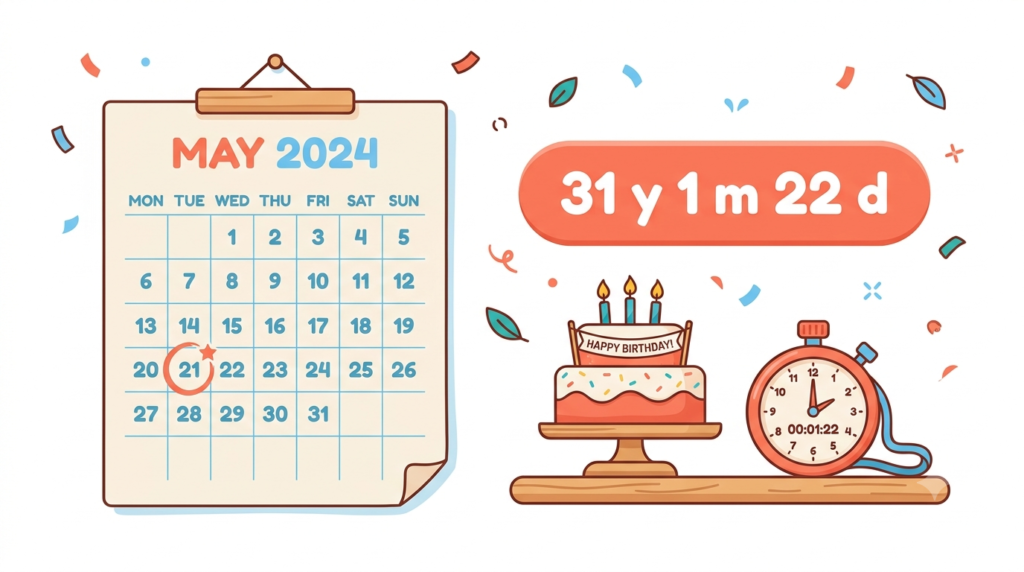
This guide shows you how to calculate age accurately by hand, step by step. You will learn the borrowing method for years, months and days, how to find total days, weeks, months and even hours lived, how to count down to your next birthday, how leap years and leap-day birthdays work, how “age as on a date” is used in eligibility rules, and how different cultures count age. To calculate instantly, use our free age calculator.
Quick Answer: How to Calculate Age
- Subtract the birth year from the target year.
- If the birthday has not yet occurred in the target year, subtract 1.
- For months and days, count forward from your last birthday to the target date.
Example: born 15 August 1995, on 7 October 2026 the age is 31 years, 1 month and 22 days.
Step 1: Age in Completed Years
Your age in completed years is the number of birthdays you have already had. The method is:
- Take the target year and subtract your birth year.
- Compare the target date with your birthday in the target year. If your birthday is still to come, subtract 1 from the result.
Example 1
Born 15 August 1995. Target date: 7 October 2026. Year difference = 2026 − 1995 = 31. Has the birthday (15 August) already passed in 2026? Yes. So the age is 31 years.
Example 2
Same birth date, but the target date is 3 March 2026. Year difference = 31. The birthday (15 August) has not yet occurred in 2026, so subtract 1. The age is 30 years.
This logic matters whenever a rule says “at least 18 years old”. Someone who will turn 18 next week is still 17 today.
Exact Age in Years, Months and Days
Many forms ask for a full breakdown. The simplest way to think about it is to count forward from your last birthday.
Worked Example: Born 15 August 1995, Target 7 October 2026
- Years: your last birthday was 15 August 2026, so you have completed 31 years.
- Months: from 15 August to 15 September 2026 is 1 month.
- Days: from 15 September to 7 October is 22 days (15 days left in September, since September has 30 days, plus 7 days in October).
Result: 31 years, 1 month, 22 days.
The Borrowing Method
Another way is to subtract dates directly, as in school subtraction, and “borrow” when a part is too small. Write the target date and the birth date as day, month and year.
Example: Born 22 November 1998, Target 7 October 2026
| Year | Month | Day | |
|---|---|---|---|
| Target date | 2026 | 10 | 7 |
| Birth date | 1998 | 11 | 22 |
- Days: 7 − 22 is negative, so borrow one month. Add the number of days in the previous month. The month before October is September, which has 30 days. So days = 7 + 30 − 22 = 15, and the target month becomes 9.
- Months: 9 − 11 is negative, so borrow one year (12 months). Months = 9 + 12 − 11 = 10, and the target year becomes 2025.
- Years: 2025 − 1998 = 27.
Result: 27 years, 10 months, 15 days.
Check by counting forward: last birthday 22 November 2025 (27 years). From 22 November 2025 to 22 September 2026 is 10 months. From 22 September to 7 October is 8 + 7 = 15 days (September has 30 days, so 30 − 22 = 8 remaining, plus 7). ✓
Different tools disagree slightly on which month’s length to use when borrowing days, which can produce a one-day difference in unusual cases. The “count forward from your last birthday” method is the most common and the easiest to explain.
Age in Total Months, Weeks, Days and Hours
Total Months
Total months = Years × 12 + Months. For 31 years and 1 month: 31 × 12 + 1 = 373 months.
Total Days
Count the days between the two dates, remembering leap years. Using the same example (15 August 1995 to 7 October 2026):
- From 15 August 1995 to 15 August 2026 is 31 years. That is 31 × 365 = 11,315 days, plus one extra day for each leap day (29 February) in between. The leap years in that period are 1996, 2000, 2004, 2008, 2012, 2016, 2020 and 2024, which is 8 leap days. Total = 11,315 + 8 = 11,323 days.
- From 15 August 2026 to 7 October 2026: 16 days left in August (to the 31st), 30 days in September and 7 days in October gives 16 + 30 + 7 = 53 days.
- Total age in days = 11,323 + 53 = 11,376 days.
Total Weeks
11,376 ÷ 7 = 1,625.14, so about 1,625 weeks and 1 day.
Total Hours
11,376 × 24 = 273,024 hours, ignoring the exact time of birth.
A Quick Approximation
If you only need a rough figure, multiply age in years by 365.25. For 31 years: 31 × 365.25 = 11,322.75, close to the 11,323 found above for 31 years. The 0.25 accounts for one leap day every four years. A more exact long-run average is 365.2425 days per year, as explained in the leap year section below.
| Unit | Value |
|---|---|
| Years, months, days | 31 years, 1 month, 22 days |
| Months | 373 (plus 22 days) |
| Weeks | 1,625 (plus 1 day) |
| Days | 11,376 |
| Hours | 273,024 |
For general conversions between time units, see our guide on unit conversion basics.
Days Until Your Next Birthday
To count down to your next birthday, find the date of the next occurrence and count the days between today and then.
Example
Born 15 August. Today is 7 October 2026. The next birthday is 15 August 2027.
- 7 October to 31 October: 24 days.
- November 30, December 31, January 31, February 28 (2027 is not a leap year), March 31, April 30, May 31, June 30, July 31: 30 + 31 + 31 + 28 + 31 + 30 + 31 + 30 + 31 = 273.
- 1 August to 15 August: 15 days.
- Total = 24 + 273 + 15 = 312 days.
A shortcut: you already know it has been 53 days since your last birthday, and a (non-leap) year has 365 days between birthdays, so 365 − 53 = 312. ✓ When the span includes a 29 February, the year has 366 days, and the shortcut uses 366.
The same counting technique is the basis of the general method in our guide on the date difference calculator.
Leap Years and Leap-Day Birthdays
A year is a leap year if it is divisible by 4, except for century years, which must be divisible by 400. So 2024 and 2028 are leap years, 2000 was a leap year, but 1900 and 2100 are not. Because of this rule, the average length of a Gregorian calendar year is 365.2425 days.
Born on 29 February
People born on 29 February (sometimes called “leaplings”) only have a calendar birthday every four years. In other years, the legal birthday depends on local law and custom. In some places, it is treated as 28 February, and in others as 1 March. For example, many legal systems use 1 March for certain purposes, such as when a person turns 18, while others use 28 February. Check the rule that applies to you when it matters for legal documents.
Calculating Age for a Leapling
Born 29 February 2000, target date 7 October 2026. Year difference = 26. The birthday (28 February or 1 March) has passed, so the age is 26 years. For exact months and days, count from the last birthday you adopt. If you treat 28 February 2026 as the birthday: 7 months to 28 September, and 9 days to 7 October (2 left in September + 7). That gives 26 years, 7 months, 9 days. If you treat 1 March 2026 as the birthday, the answer is 26 years, 7 months, 6 days (1 March to 1 October is 7 months, plus 6 days to reach 7 October). The two conventions therefore differ by three days in the days count. This is why official forms usually ask only for completed years.
Age as on a Cut-Off Date
Government exams, recruitment drives, school admissions and sports competitions often say “age as on 1 January 2027” or “must be between 18 and 30 years as on the closing date”. In that case, you compute your age on that specific date, not on today’s date.
Example
Born 12 March 1996. Age as on 1 January 2027:
- Last birthday before the cut-off: 12 March 2026 (30 years).
- From 12 March to 12 December 2026 is 9 months.
- From 12 December 2026 to 1 January 2027 is 20 days (19 days left in December plus 1).
Age = 30 years, 9 months, 20 days.
Reading the Rule Carefully
- “Minimum 18 years” means you must have completed 18 years on the cut-off date.
- “Maximum 30 years” or “not exceeding 30 years” usually means you must not have completed 31 years. The person above at 30 years 9 months 20 days would meet this.
- “Below 30 years” or “less than 30 years” often means you must not have completed 30 years.
- Relaxations for certain categories add extra years to the upper limit. Always read the official notification.
Because a one-day difference can decide eligibility, always check the exact wording and cut-off date in the official notice.
How Different Cultures Count Age
The method above is called “international age” or “Western age”. Some East Asian traditions use different systems.
- Traditional East Asian age: a baby is considered one year old at birth, counting time in the womb, and everyone adds a year at the Lunar New Year (or on 1 January, in some versions). As a result, a person’s traditional age can be one or two years higher than their international age.
- Official use: several countries have standardised on international age for legal and administrative purposes. South Korea, for example, changed its official rules in 2023 so that international age is used in most legal and administrative contexts, although traditional counting still appears in everyday speech.
- Insurance “age nearest birthday”: some insurers use age at the nearest birthday, so someone who is 31 years and 8 months old might be rated as 32.
If you are filling in a form from another country, check which definition it uses.
Which Day of the Week Were You Born?
Because 7 divides awkwardly into the days of a year, you can work out the weekday of any date. One simple approach uses a known reference. For example, 1 January 1995 was a Sunday. To find 15 August 1995:
- Count the day of the year: January 31 + February 28 + March 31 + April 30 + May 31 + June 30 + July 31 = 212, plus 15 = day 227.
- Days after 1 January = 227 − 1 = 226.
- 226 mod 7 = 226 − 224 = 2.
- Sunday + 2 days = Tuesday.
So 15 August 1995 was a Tuesday. The key idea is that every 7 days brings you back to the same weekday, so only the remainder after dividing by 7 matters. There are also formulas, such as Zeller’s congruence, that give the weekday directly from the date, and our age calculator shows the weekday automatically.
Why Exact Age Matters
- Education: minimum age for school admission is typically measured on a fixed date.
- Jobs and exams: eligibility often has a minimum and maximum age as on a cut-off date.
- Legal milestones: voting, driving, marriage, signing contracts and retirement age depend on completed years.
- Insurance and finance: premiums and pension benefits are based on age. If you are planning savings goals, our guides to the SIP calculator and compound interest show how the number of years until a milestone changes what you need to invest.
- Health: screening, dosing and growth charts use exact age. Calculators for BMR and other health measures take age as an input.
- Sports: age categories in competitions often use age on a specific date or birth year.
- Personal interest: celebrating “10,000 days old”, counting to a milestone birthday or planning anniversaries.
A Fun Milestone
For the example birth date of 15 August 1995, the 11,000th day was 15 August 1995 plus 11,000 days. The person above reached 11,000 days on a date 376 days before 7 October 2026, since they are now at 11,376 days. Counting back 376 days from 7 October 2026 gives 26 September 2025 (7 October 2026 minus 365 days is 7 October 2025, and 11 more days back is 26 September 2025). Milestone days like 10,000 and 20,000 are popular to celebrate.
Spreadsheet Formulas
If you use Excel or Google Sheets, you can calculate age without doing the maths by hand. Suppose the birth date is in cell A1 and the target date is in B1.
- Completed years: =DATEDIF(A1, B1, “Y”)
- Months after the last birthday: =DATEDIF(A1, B1, “YM”)
- Days after the last full month: =DATEDIF(A1, B1, “MD”)
- Total days: =B1 – A1
- Today’s age in years: =DATEDIF(A1, TODAY(), “Y”)
Make sure the cells are formatted as dates. The “MD” option can behave unexpectedly in some versions for certain date combinations, so verify important results with a second method or a trusted calculator.
Common Mistakes
- Forgetting that the birthday may not have occurred yet. Subtracting years alone can overstate age by one.
- Using 30 days for every month. Months have 28 to 31 days.
- Ignoring leap years when counting total days.
- Using today’s date instead of the cut-off date for eligibility.
- Mixing “inclusive” and “exclusive” counting. Check whether the first and last day are both counted.
- Misreading “below 30” and “up to 30”. These can mean different things.
- Assuming everyone counts age the same way. Cultures and companies may differ.
- Entering dates in the wrong order. 03/04/2026 is 3 April in some countries and 4 March in others. The ISO format (2026-04-03) avoids confusion.
Practice Questions
- Find the age on 7 October 2026 of a person born on 15 August 1995, in years, months and days.
- How many days until the next birthday for someone born on 15 August, on 7 October 2026?
- Find the age as on 1 January 2027 for a person born on 12 March 1996.
- How many months old is a person who is 31 years and 1 month old?
- Approximately how many days are in 30 years, using 365.25 days per year?
- A person was born on 29 February 2000. How old are they in whole years on 7 October 2026?
Answers
- 31 years, 1 month, 22 days.
- 312 days.
- 30 years, 9 months, 20 days.
- 31 × 12 + 1 = 373 months.
- 30 × 365.25 = 10,957.5, or about 10,958 days.
- 2026 − 2000 = 26 years, since the birthday (28 February or 1 March) has already passed.
Frequently Asked Questions
How do I calculate my exact age?
Subtract your birth date from the target date in years, months and days, borrowing when needed. If your birthday has not occurred yet this year, subtract one from the year difference.
How do I calculate age in days?
Count the days between your birth date and the target date, including leap days. A rough method is to multiply years by 365.25.
How is age calculated for a leap-day birthday?
The birthday is treated as 28 February or 1 March in non-leap years, depending on local rules. Completed years are usually the same either way.
What does “age as on” a date mean?
It is your completed age on that particular cut-off date, which is used for eligibility in exams, jobs and admissions.
Why do some countries count age differently?
Traditional East Asian counting makes a baby one year old at birth and adds a year at New Year, so traditional age is often higher. Many countries now use international age for official purposes.
How many days are in an average year?
The average Gregorian year is 365.2425 days, which accounts for leap years.
Does the time of birth matter?
For legal age in years, only the date matters in most places. For age in hours or minutes, the time of birth and time zone matter.
Conclusion
Calculating exact age is straightforward once you follow the method: count completed years, then months, then days from your last birthday. Remember that leap years change the day totals, that “age as on a date” must use the cut-off date, and that cultures and organisations sometimes count differently. Check the wording on any form carefully, because a single day can decide eligibility.
For instant results, use our free age calculator, and keep learning with these related guides: