
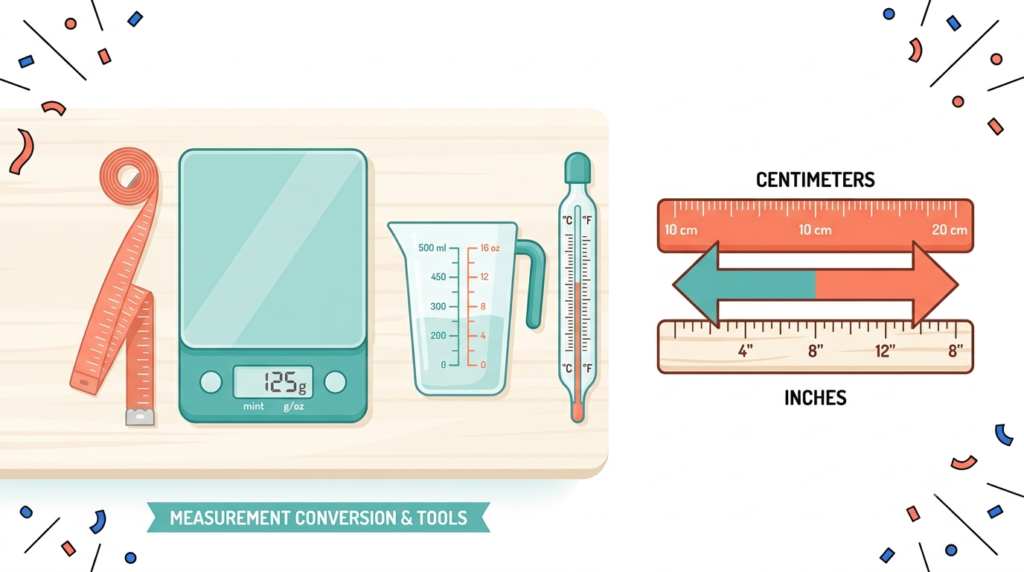
A recipe from a foreign website asks for 8 ounces of flour, but your scale shows grams. A bike route is listed as 25 miles, and you wonder how far that is in kilometres. A medicine label shows milligrams, but the doctor spoke in micrograms. A car’s speed is shown in miles per hour on a foreign road sign. Every day, we meet quantities measured in units we are less familiar with, and we need to convert them.
Unit conversion can seem confusing at first, but it follows one simple idea: you are changing the unit, not the amount. Once you know the conversion factor, you can convert anything, from centimetres to kilometres, tablespoons to millilitres and miles per hour to metres per second. In this guide, you will learn the conversion factor method (also called dimensional analysis), the metric prefixes, how to handle area and volume, how to convert speed, temperature and time, how to deal with rounding, and how to avoid the common mistakes. There are tables of the most useful conversions, plus practice questions. For instant results, use our free unit converter.
Quick Answer: How to Convert Units
Multiply by a conversion factor written as a fraction equal to 1, arranged so that the unit you want to remove cancels.
Example: convert 5 kilometres to metres. Since 1 km = 1,000 m, we write 5 km × (1,000 m ÷ 1 km) = 5 × 1,000 m = 5,000 m. The “km” cancels, leaving metres.
What Is a Unit?
A measurement has two parts: a number and a unit. “5” alone means nothing, but “5 kilometres” is a distance. The unit tells you what kind of quantity you are measuring and how large each step is.
Quantities are grouped into types, called dimensions or categories. Within each type, there are many units:
- Length (distance): millimetre, centimetre, metre, kilometre, inch, foot, yard, mile.
- Mass (weight): milligram, gram, kilogram, tonne, ounce, pound, stone.
- Volume (capacity): millilitre, litre, cubic metre, teaspoon, cup, pint, gallon.
- Area: square metre, hectare, square foot, acre.
- Time: second, minute, hour, day, week, year.
- Temperature: Celsius, Fahrenheit, Kelvin.
- Speed: metres per second, kilometres per hour, miles per hour, knots.
- Data: bit, byte, kilobyte, megabyte, gigabyte, terabyte.
You can only convert between units of the same type. You can change kilometres to miles, but you cannot convert kilograms to metres. That would be like asking how many apples are in a litre.
Most of the world uses the metric system (also called SI), while the United States and a few other places use customary units such as inches, pounds and gallons. We compare the two systems in our guide on metric vs imperial.
The Conversion Factor Method
A conversion factor is a ratio that equals 1 because the top and bottom represent the same quantity in different units. For example, 1 km = 1,000 m, so the fractions (1,000 m ÷ 1 km) and (1 km ÷ 1,000 m) both equal 1. Multiplying by 1 does not change the value, only its unit.
The Steps
- Write the starting quantity with its unit.
- Choose the conversion factor, and write it as a fraction with the unwanted unit on the bottom and the wanted unit on the top.
- Multiply. The unwanted unit cancels.
- Calculate the number and write the answer with the new unit.
Example 1: Hours to Minutes
Convert 2.5 hours to minutes. 2.5 h × (60 min ÷ 1 h) = 150 min.
Example 2: Pounds to Kilograms
Convert 150 lb to kg. We know 1 kg ≈ 2.20462 lb. 150 lb × (1 kg ÷ 2.20462 lb) = 150 ÷ 2.20462 ≈ 68.04 kg.
Example 3: Miles to Kilometres
Convert 10 miles to km. 1 mile = 1.609344 km. 10 mi × (1.609344 km ÷ 1 mi) ≈ 16.09 km.
A Simple Rule to Remember
When converting to a smaller unit, you need more of them, so the number gets bigger (5 km becomes 5,000 m). When converting to a larger unit, you need fewer of them, so the number gets smaller (5,000 m becomes 5 km). Use this to check that your answer is sensible.
Metric Prefixes
The metric system is built on powers of ten, which makes conversions within it very simple. A prefix tells you how many times larger or smaller a unit is than the base unit.
| Prefix | Symbol | Factor | Meaning |
|---|---|---|---|
| giga | G | 10⁹ | 1,000,000,000 |
| mega | M | 10⁶ | 1,000,000 |
| kilo | k | 10³ | 1,000 |
| hecto | h | 10² | 100 |
| (base unit) | 10⁰ | 1 | |
| deci | d | 10⁻¹ | 0.1 |
| centi | c | 10⁻² | 0.01 |
| milli | m | 10⁻³ | 0.001 |
| micro | µ | 10⁻⁶ | 0.000001 |
| nano | n | 10⁻⁹ | 0.000000001 |
Moving the Decimal Point
Because every step is a power of ten, converting within the metric system just means moving the decimal point. Going to a smaller unit moves the decimal point to the right; going to a larger unit moves it to the left.
- 3.5 km = 3,500 m (move 3 places right).
- 250 cm = 2.5 m (move 2 places left).
- 0.75 kg = 750 g (move 3 places right).
- 45 mL = 0.045 L (move 3 places left).
- 2 mg = 2,000 µg (move 3 places right).
This is the same idea as scientific notation. For very big or very small numbers, our guide on scientific notation shows how powers of ten are used to write them compactly.
Chain Conversions
Sometimes there is no direct factor between two units, so you use a chain of factors. Write them one after another so that each intermediate unit cancels.
Example 1: Miles to Metres
1 mile = 1.609344 km, and 1 km = 1,000 m. 5 mi × (1.609344 km ÷ 1 mi) × (1,000 m ÷ 1 km) = 5 × 1.609344 × 1,000 = 8,046.72 m.
Example 2: Days to Seconds
1 day = 24 h, 1 h = 60 min, 1 min = 60 s. 1 day × (24 h ÷ 1 day) × (60 min ÷ 1 h) × (60 s ÷ 1 min) = 24 × 60 × 60 = 86,400 s.
Example 3: Feet to Centimetres via Inches
6 ft × (12 in ÷ 1 ft) × (2.54 cm ÷ 1 in) = 6 × 12 × 2.54 = 182.88 cm.
If you ever lose track, write out the units and cancel them one pair at a time. If the units on the left of your answer do not match what you want, you have set up the factor upside down.
Area and Volume Conversions
This is where many people go wrong. For area, you square the linear factor. For volume, you cube it.
Area
Since 1 m = 100 cm, an area of 1 m² is a square 100 cm by 100 cm = 10,000 cm². So 1 m² = 10,000 cm², not 100 cm².
- 3 m² = 3 × 10,000 = 30,000 cm².
- 1 km² = 1,000 × 1,000 = 1,000,000 m².
- 1 hectare = 10,000 m² (a square of 100 m by 100 m).
- 1 acre ≈ 4,046.86 m². So 1 hectare ≈ 2.471 acres.
- 1 m² ≈ 10.7639 ft². So a room of 120 ft² is about 120 × 0.092903 = 11.15 m².
Volume
1 m = 100 cm, so 1 m³ = 100 × 100 × 100 = 1,000,000 cm³. Since 1 litre = 1,000 cm³:
- 1 m³ = 1,000 L.
- 1 L = 1,000 mL = 1,000 cm³, so 1 mL = 1 cm³.
- 1 US gallon = 3.78541 L, while 1 imperial (UK) gallon = 4.54609 L.
Example: A water tank measures 2 m by 1.5 m by 1 m. Volume = 3 m³ = 3,000 L. At about 1 kg per litre of water, that is about 3,000 kg of water.
For area measures, you may also meet local units such as the bigha, gaj or katha in India, whose sizes vary by state. Always check the local definition before converting.
| Quantity | Conversion |
|---|---|
| 1 m² | 10,000 cm² ≈ 10.764 ft² |
| 1 hectare | 10,000 m² ≈ 2.471 acres |
| 1 acre | ≈ 4,046.86 m² = 43,560 ft² |
| 1 ft² | ≈ 0.0929 m² |
| 1 m³ | 1,000 L = 1,000,000 cm³ ≈ 35.31 ft³ |
| 1 L | 1,000 mL ≈ 0.2642 US gallons |
Converting Speed and Other Compound Units
Compound units, such as speed (distance per time), need two conversions at once.
Kilometres per Hour to Metres per Second
72 km/h × (1,000 m ÷ 1 km) × (1 h ÷ 3,600 s) = 72,000 ÷ 3,600 = 20 m/s.
The shortcut: divide km/h by 3.6 to get m/s, and multiply m/s by 3.6 to get km/h.
Miles per Hour to Kilometres per Hour
60 mph × 1.609344 = 96.56 km/h. As a rough check, miles are about 60% longer than kilometres, so speeds in km/h are about 1.6 times those in mph.
Knots
One knot is one nautical mile per hour. A nautical mile is exactly 1.852 km, so 1 knot = 1.852 km/h. A ship travelling at 20 knots goes 20 × 1.852 = 37.04 km/h.
Density, Fuel Economy and Pressure
- Density: 1 g/cm³ = 1,000 kg/m³.
- Fuel economy: miles per US gallon can be converted to km per litre using 1.609344 ÷ 3.78541 ≈ 0.4251. So 30 mpg ≈ 12.75 km/L.
- Pressure: 1 bar = 100,000 pascals ≈ 14.5 psi.
Temperature Conversion
Temperature is different from other units because the scales do not start at the same zero point. You cannot just multiply by a factor; you must also add or subtract an offset.
Formulas
- Celsius to Fahrenheit: °F = °C × 9/5 + 32
- Fahrenheit to Celsius: °C = (°F − 32) × 5/9
- Celsius to Kelvin: K = °C + 273.15
Examples
- 37 °C = 37 × 1.8 + 32 = 98.6 °F (normal body temperature).
- 98.6 °F = (98.6 − 32) × 5/9 = 66.6 × 0.5556 ≈ 37 °C.
- 100 °C = 212 °F (boiling point of water at sea level).
- 0 °C = 32 °F = 273.15 K (freezing point of water).
- −40 °C = −40 °F, the point where the two scales meet.
A rough mental method for Celsius to Fahrenheit: double the number and add 30. For 20 °C, that gives 70 °F (the exact value is 68). It is only approximate, and the error grows at extreme temperatures, but it is good enough for a quick weather check.
Time Conversions
Time units are not based on tens, which makes them trickier. The key facts are:
- 1 minute = 60 seconds; 1 hour = 60 minutes = 3,600 seconds.
- 1 day = 24 hours = 1,440 minutes = 86,400 seconds.
- 1 week = 7 days = 168 hours.
- 1 year = 365 days (366 in a leap year), and on average 365.2425 days.
To convert hours and minutes to decimal hours, divide the minutes by 60, as shown in our guide on calculating working hours. For counting days between dates, see the date difference calculator guide, and for converting clock times across regions, see our time zone converter guide.
Common Conversion Tables
| From | To |
|---|---|
| 1 inch | 2.54 cm (exactly) |
| 1 foot | 30.48 cm = 12 inches |
| 1 yard | 0.9144 m = 3 feet |
| 1 mile | 1.609344 km = 1,760 yards = 5,280 feet |
| 1 km | ≈ 0.6214 miles |
| 1 nautical mile | 1.852 km |
| From | To |
|---|---|
| 1 kg | 1,000 g ≈ 2.20462 lb |
| 1 lb | ≈ 453.592 g = 16 oz |
| 1 oz | ≈ 28.3495 g |
| 1 tonne | 1,000 kg |
| 1 quintal (India) | 100 kg |
| From | To |
|---|---|
| 1 litre | 1,000 mL ≈ 33.81 US fl oz |
| 1 US gallon | ≈ 3.78541 L |
| 1 imperial gallon | ≈ 4.54609 L |
| 1 US cup | ≈ 236.6 mL |
| 1 tablespoon (metric) | 15 mL |
| 1 teaspoon (metric) | 5 mL |
Indian Number Units
Not a unit of measurement but often needed: 1 lakh = 100,000 and 1 crore = 10,000,000 (100 lakh). So 2.5 crore = 25,000,000 = 25 million.
Cooking and Everyday Conversions
Recipes often use cups and spoons, while kitchen scales use grams. Volume and mass depend on what you are measuring, because different ingredients have different densities. Water is easy (1 mL ≈ 1 g), but flour, sugar and rice are not.
- Plain flour: 1 US cup is roughly 120 to 125 g.
- Granulated sugar: 1 US cup is roughly 200 g.
- Butter: 1 US cup is about 227 g (2 sticks).
- Water or milk: 1 US cup is about 237 g.
These figures are approximate and vary with how you pack the cup. For accurate baking, a scale is better.
Examples
- 8 oz of flour = 8 × 28.35 = 226.8 g.
- 2 cups of water = 2 × 236.6 ≈ 473 mL.
- 350 °F oven = (350 − 32) × 5/9 ≈ 177 °C (often rounded to 180 °C).
For health-related conversions, such as converting weight in pounds when calculating BMI, see our guide to the BMI calculator. Fluid needs can be converted from millilitres to glasses, as in our water intake guide.
Rounding and Significant Figures
When converting, the answer should not look more precise than the original measurement. If you measure a length as “5 ft” with a rough tape, converting to “152.4 cm” gives a false sense of precision. Round to a sensible number, such as 152 cm.
- Keep extra digits during the calculation, and round only at the end.
- Some conversion factors are exact by definition (1 inch = 2.54 cm; 1 lb = 0.45359237 kg), while others, like 1 kg ≈ 2.20462 lb, are rounded values.
- Use the number of significant figures in your original measurement as a guide for the answer.
- For everyday use, two or three significant figures are usually enough.
Significant figures and scientific notation work together, and you can read more in our scientific notation guide.
Mental Math Shortcuts
- Kilometres to miles: multiply by 0.6 (more precisely 0.62). 100 km ≈ 62 miles.
- Miles to kilometres: multiply by 1.6. 10 miles ≈ 16 km.
- Kilograms to pounds: double it and add 10%. 50 kg ≈ 100 + 10 = 110 lb (exact: 110.2).
- Pounds to kilograms: halve it and subtract 10%. 150 lb ≈ 75 − 7.5 = 67.5 kg (exact: 68.04).
- Inches to centimetres: multiply by 2.5. 10 in ≈ 25 cm (exact: 25.4).
- Litres to US gallons: divide by 4 (about). 20 L ≈ 5 gallons (exact: 5.28).
- km/h to m/s: divide by 3.6, or divide by 4 for a rough guess and add a bit.
- Celsius to Fahrenheit: double and add 30 for a rough figure.
These shortcuts rely on easy percentages, which are explained in our guide on how to calculate percentage.
Common Mistakes
- Using the conversion factor upside down. Always check that the unit you want to remove cancels.
- Forgetting to square or cube factors for area and volume. 1 m² is 10,000 cm², not 100 cm².
- Mixing up the US and imperial gallons, pints and fluid ounces. They differ in size.
- Confusing mass and weight units. Kilograms and pounds measure mass in everyday use. A tonne is 1,000 kg, but a “short ton” in the US is 2,000 lb.
- Treating temperature like other units. You must add or subtract an offset.
- Dropping units during the calculation. Writing units at each step catches most errors.
- Over-rounding in the middle of a calculation. Round only at the end.
- Converting between different quantity types. You cannot convert length to mass.
- Using outdated currency or exchange conversions. Currency rates change continuously, unlike physical units, so always use a current rate.
Practice Questions
- Convert 3.5 km to metres.
- Convert 90 minutes to hours.
- Convert 72 km/h to m/s.
- Convert 150 lb to kilograms.
- Convert 3 m² to cm².
- Convert 98.6 °F to °C.
Answers
- 3.5 × 1,000 = 3,500 m.
- 90 ÷ 60 = 1.5 hours.
- 72 ÷ 3.6 = 20 m/s.
- 150 ÷ 2.20462 ≈ 68.04 kg.
- 3 × 10,000 = 30,000 cm².
- (98.6 − 32) × 5/9 = 37 °C.
Frequently Asked Questions
What is the easiest way to convert units?
Multiply by a conversion factor written as a fraction equal to 1, set up so the unwanted unit cancels. 5 km × (1,000 m ÷ 1 km) = 5,000 m.
How do I convert km/h to m/s?
Divide by 3.6. For instance, 72 km/h is 20 m/s. To go the other way, multiply by 3.6.
How do I convert square units?
Square the linear conversion factor. Since 1 m = 100 cm, 1 m² = 10,000 cm².
How do I convert Celsius to Fahrenheit?
Multiply by 9/5 (1.8) and add 32. 37 °C is 98.6 °F.
What is dimensional analysis?
It is the method of tracking units through a calculation so they cancel correctly, which helps you check your setup.
Why do conversions sometimes give slightly different answers?
Sources round conversion factors differently, and some units, such as US and imperial gallons, share a name but differ in size.
Are currency conversions the same as unit conversions?
No. Physical unit factors are fixed, but exchange rates change daily and depend on the provider and fees.
Conclusion
Unit conversion is a skill that rewards a clear method. Write your units down, multiply by a conversion factor that equals 1, make sure the unwanted unit cancels, remember to square or cube the factor for area and volume, treat temperature separately, and round sensibly. With practice, you will be able to move between metric and customary units, and between time, speed and everyday measurements, with confidence.
For fast, accurate answers, use our free unit converter, and keep learning with these related guides:
Pingback: Ideal Body Weight: Formulas, Healthy Weight Range & Examples (2026 Guide) - Free Tool Calculators
Pingback: Time Zone Converter Guide: How to Convert Time Between Zones, UTC & DST (2026) - Free Tool Calculators
Pingback: Length Converter Guide: cm to Inches, Feet and Inches, Metres & Miles (2026) - Free Tool Calculators