
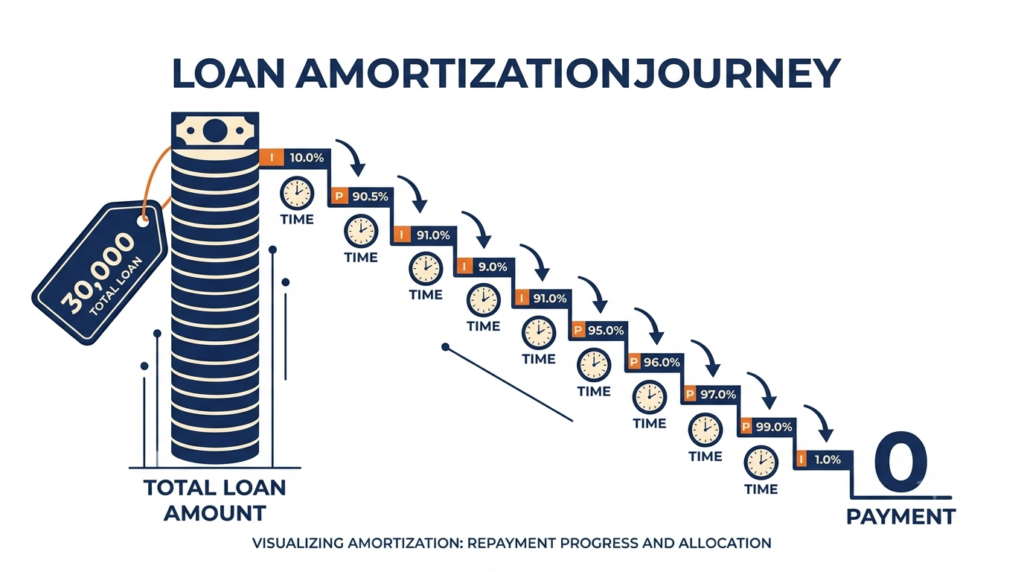
When you take a loan and agree to pay a fixed EMI every month, one question naturally follows: where does each payment actually go? You pay the same amount every month, yet your lender’s statement shows the balance falling slowly at first and faster later. The explanation is amortization.
Loan amortization is the process of paying off a debt through regular instalments that cover both interest and principal. A table that lists every payment, and how it is divided, is called an amortization schedule. Understanding it helps you see the real cost of a loan, decide whether to prepay and compare lenders more intelligently.
In this guide you will learn how amortization works, how to build a schedule step by step, how to find the balance at any point, why early payments are mostly interest, how prepayment changes the picture and what mistakes to avoid. If you are new to EMIs, begin with our guide on how EMI is calculated. To generate a full schedule instantly, use our free loan amortization calculator.
Quick Answer: What Is Loan Amortization?
Loan amortization means repaying a loan with equal periodic payments, where each payment first covers the interest due and the rest reduces the principal.
- Interest for the month = Opening balance × monthly rate.
- Principal repaid = Payment − Interest.
- Closing balance = Opening balance − Principal repaid.
Because the balance falls every month, the interest part shrinks and the principal part grows, while the total payment stays the same.
What Is Amortization?
The word comes from an old term meaning “to deaden” or “to kill off”. In lending, it means gradually killing off a debt. Instead of paying the entire loan in one go at the end, you pay it off in small pieces over time. By the final instalment, the outstanding balance is exactly zero.
Three features define a standard amortizing loan:
- Fixed schedule: payments are due at regular intervals, usually monthly.
- Equal payments: in the common “equated” structure, each instalment is the same amount.
- Declining balance: interest is charged on what you still owe, not on the original amount.
Home loans, car loans, education loans and most personal loans from banks follow this structure. Because interest is charged on the reducing balance, the maths is closely related to compound interest, run in reverse: instead of your money growing, your debt shrinks.
How the Three Columns Work
An amortization schedule has three key columns for every payment.
1. Interest
Interest for the month = Opening balance × Monthly rate. The monthly rate is the annual rate divided by 12 and by 100. For a 12% annual rate, the monthly rate is 0.01.
2. Principal
Principal repaid = Payment − Interest. This is the part that actually reduces what you owe.
3. Closing Balance
Closing balance = Opening balance − Principal repaid. This becomes the opening balance for the next month.
Repeat these three steps until the balance reaches zero. A fourth column, the opening balance, is sometimes shown for clarity, and many lenders add a column for cumulative interest paid.
A Complete Schedule: Month by Month
Let us build a full schedule for a small loan, so every number is visible. Take a loan of 1,00,000 at 12% a year for 6 months.
Step 1: Calculate the EMI
Monthly rate r = 12 ÷ 12 ÷ 100 = 0.01, and n = 6. Using the formula EMI = P × r × (1 + r)ⁿ ÷ [(1 + r)ⁿ − 1]:
- (1.01)⁶ ≈ 1.061520.
- EMI = 1,00,000 × 0.01 × 1.061520 ÷ 0.061520 ≈ 17,254.84.
Step 2: Fill in the Schedule
| Month | Opening balance | Interest | Principal | Closing balance |
|---|---|---|---|---|
| 1 | 1,00,000.00 | 1,000.00 | 16,254.84 | 83,745.16 |
| 2 | 83,745.16 | 837.45 | 16,417.39 | 67,327.77 |
| 3 | 67,327.77 | 673.28 | 16,581.56 | 50,746.21 |
| 4 | 50,746.21 | 507.46 | 16,747.38 | 33,998.83 |
| 5 | 33,998.83 | 339.99 | 16,914.85 | 17,083.98 |
| 6 | 17,083.98 | 170.84 | 17,084.00 | ≈ 0 |
The tiny leftover in the last row is a rounding difference, which lenders adjust in the final payment. Total interest paid ≈ 3,529 (the sum of the interest column), and total repaid = 17,254.84 × 6 ≈ 1,03,529.
What the Table Teaches
- The payment is constant at 17,254.84, but the interest falls from 1,000.00 to 170.84.
- The principal repaid rises from 16,254.84 to 17,084.00.
- Interest in month 1 is exactly 1% of 1,00,000 because the monthly rate is 1%.
What a Long Loan Looks Like
The same pattern becomes dramatic on a long loan. Consider ₹10,00,000 at 9% for 10 years, with an EMI of about ₹12,668. The table below shows approximate yearly totals.
| Period | Total paid in the year | Interest part | Principal part |
|---|---|---|---|
| Year 1 | ₹1,52,000 | about ₹87,400 | about ₹64,600 |
| Year 10 (last year) | ₹1,52,000 | about ₹7,150 | about ₹1,44,850 |
In year one, more than half of everything you pay is interest. In the last year, less than 5% is interest. At the halfway mark, after 5 years, you have paid 50% of the payments but cleared only about 39% of the original loan. Roughly ₹6.10 lakh of the principal is still outstanding. Many borrowers are surprised by this, but it follows directly from interest being charged on a large balance early on.
Finding the Balance at Any Time
You do not need the full schedule to know how much you still owe after k payments. Use this formula:
Balance after k payments = P × (1 + r)ᵏ − EMI × [((1 + r)ᵏ − 1) ÷ r]
The first part shows how the original loan would have grown with interest, and the second part subtracts the growth of your payments. Here is an example.
Example: Balance After 1 Year
For ₹10,00,000 at 9% (r = 0.0075) and EMI ₹12,668, after 12 payments:
- (1.0075)¹² ≈ 1.093807.
- First part = 10,00,000 × 1.093807 = 10,93,807.
- Second part = 12,668 × (0.093807 ÷ 0.0075) = 12,668 × 12.5076 ≈ 1,58,440.
- Balance ≈ 10,93,807 − 1,58,440 ≈ ₹9,35,367.
So after a full year of payments totalling about ₹1.52 lakh, you have repaid only about ₹64,600 of principal. This calculation uses exponents; if they feel unfamiliar, review our guide on square roots and exponents.
The Remaining Payments Method
You can also find the balance by working out the present value of your remaining payments: Balance = EMI × [1 − (1 + r)^(−m)] ÷ r, where m is the number of payments left. For the same loan, after 9 years only 12 payments remain, and the balance is the value of those 12 payments, which comes to about ₹1,44,860.
Why Interest Is Front-Loaded
Interest is calculated on the outstanding balance. At the start, you owe the full amount, so interest is at its highest. Your EMI first has to cover that big interest figure, which leaves only a small portion to reduce the principal. As the balance falls, interest falls too, and more of the same EMI is freed up to attack the principal. That, in turn, reduces the balance faster, in a self-reinforcing cycle.
This has three practical consequences:
- Early prepayments are powerful. Reducing the balance while it is large saves the most interest.
- Foreclosing late saves little. If you pay off a loan in its final years, you save only a small amount of interest because most of it is already paid.
- Refinancing is most valuable early. Switching to a cheaper rate in year two matters far more than in year nine.
Effect of Prepayment
A prepayment is an extra payment beyond your regular EMI that goes directly toward the principal. After a prepayment, you typically choose between keeping the EMI the same (and finishing sooner) or keeping the tenure the same (and lowering the EMI).
Example: ₹1,00,000 Prepayment After One Year
On the ₹10,00,000, 9%, 10-year loan, the balance after 12 payments is about ₹9,35,367. Suppose you pay an extra ₹1,00,000, bringing the balance to about ₹8,35,367, and keep the EMI at ₹12,668.
- Without prepayment, 108 payments remain.
- With prepayment, the loan ends after about 91 payments, which is about 17 months sooner.
- Total interest saved is roughly ₹1.1 lakh, more than the ₹1,00,000 you prepaid.
That saving is possible because the ₹1,00,000 stops accruing 9% interest for the remaining years. The earlier you prepay, the longer the interest is avoided. Before you prepay, check whether your lender charges a prepayment or foreclosure fee, and whether keeping the cash for emergencies or higher-return goals makes more sense. Our guides on SIP investing and ROI help you compare prepaying with investing.
Types of Repayment Structures
| Structure | How it works | Typical use |
|---|---|---|
| Fully amortizing (EMI) | Equal payments clear the loan to zero by the end | Home, car and personal loans |
| Equal principal | The same principal is repaid each month, so payments start high and fall | Some business and corporate loans |
| Interest-only | Only interest is paid for a period; principal is repaid later | Construction phases, some investment loans |
| Balloon | Small regular payments, then a large final payment | Some vehicle and commercial loans |
| Negative amortization | Payments are less than the interest, so the balance grows | Rare, risky; some flexible-payment products |
| Bullet | Interest regularly and the full principal at maturity | Bonds, some short-term loans |
Be especially careful with negative amortization. If your payment does not cover the interest, the unpaid amount is added to your balance, so you may owe more after months of payments than you did at the start.
Flat Rate Loans and Amortization
Some lenders quote a flat rate, where interest is calculated on the original amount for the whole tenure. Although payments are equal, the effective cost is much higher than a reducing-balance loan with the same quoted rate. We compare them in our guide on how EMI is calculated and explain the underlying idea in the simple interest formula article.
Tenure, Rate and Total Interest
Because interest depends on the balance and the time it remains outstanding, tenure has a very strong effect on cost. On ₹10,00,000 at 9%, total interest is about ₹2.45 lakh over 5 years, ₹5.20 lakh over 10 years, ₹8.26 lakh over 15 years and ₹11.59 lakh over 20 years. A longer tenure lowers each payment but keeps the balance high for longer.
Rate matters too. A difference of one percentage point on a long loan can add or save lakhs. To understand how small differences in percentage terms add up, see our guide on percentage change.
Practical Tips to Save Interest
- Read the schedule at the start. Ask your lender for the full amortization schedule and check that it matches the loan terms.
- Prepay early, not late. Extra payments in the first third of the loan save the most.
- Make one extra EMI a year. Even a small regular extra payment can shorten the tenure noticeably.
- Round up your EMI. Paying a slightly higher amount, such as ₹13,000 instead of ₹12,668, quietly reduces the balance faster.
- Compare refinancing offers early. Include fees in your comparison, not just the rate.
- Choose the tenure carefully. Pick the shortest period you can afford comfortably.
- Check prepayment terms. Some loans impose charges or minimum amounts.
- Keep an emergency fund. That prevents you from missing EMIs or borrowing at higher rates.
This guide is for education and is not financial advice. Loan terms differ by lender and country, so confirm details in your agreement.
Amortization in Accounting
Outside loans, “amortization” also describes spreading the cost of an intangible asset, such as a patent, software licence or other long-lived right, over its useful life. Here, the term is similar to depreciation for physical assets. This is a different concept from loan amortization, though both involve spreading an amount over time. In this article, we use the term in its loan sense.
Common Mistakes
- Assuming equal payments mean equal principal. The payment is equal; the principal portion rises each month.
- Using the annual rate in the monthly interest step. Divide by 12 first.
- Ignoring the front-loaded interest. Stopping or foreclosing early does not return the interest already paid.
- Forgetting fees. Processing and prepayment fees alter the real cost of a loan.
- Looking only at the EMI. A low EMI over a long tenure can hide a large total interest bill.
- Prepaying without checking the terms. Penalties may reduce the benefit.
- Overlooking rate resets. On floating-rate loans, the schedule changes when the rate changes.
- Not tracking the balance. Compare your lender’s statement with your own schedule at least once a year.
Practice Questions
Use the loan of 1,00,000 at 12% per year for 6 months (EMI ≈ 17,254.84) for the first five questions.
- What is the monthly interest rate?
- What is the interest portion of the first payment?
- What is the principal portion of the first payment?
- What is the balance after the first payment?
- What is the approximate total interest over the loan?
- Why does the interest portion fall every month while the payment stays the same?
Answers
- 12 ÷ 12 ÷ 100 = 0.01 (1% per month).
- 1,00,000 × 0.01 = 1,000.
- 17,254.84 − 1,000 = 16,254.84.
- 1,00,000 − 16,254.84 = 83,745.16.
- About 3,529 (6 × 17,254.84 − 1,00,000).
- Interest is charged on the opening balance, which falls every month, so less of the fixed payment is needed for interest and more goes to principal.
Frequently Asked Questions
What is loan amortization?
It is the repayment of a loan through regular payments, each covering the interest due and part of the principal, until the balance reaches zero.
What is an amortization schedule?
It is a table that shows, for each payment, the interest portion, the principal portion and the remaining balance.
Why is so much interest paid at the beginning?
Interest is charged on the outstanding balance, which is largest at the start. As the balance falls, the interest share falls.
How do I calculate the interest portion of a payment?
Multiply the opening balance for the month by the monthly interest rate. The remainder of the payment is principal.
Does prepayment reduce interest?
Yes. It lowers the balance, so less interest accrues in every later month, shortening the loan or reducing the EMI.
What is negative amortization?
It happens when payments are less than the interest due, so the unpaid interest is added to the balance and the loan grows.
Is amortization the same as depreciation?
No. Loan amortization is the repayment of debt over time. In accounting, amortization of intangible assets is similar to depreciation, but that is a separate use of the word.
Conclusion
An amortization schedule shows you the real mechanics of a loan. The payment is fixed, but its makeup changes constantly: interest is high at the start and low at the end, while principal does the reverse. Once you understand this, you can see why early prepayment saves so much, why long tenures cost more and why it pays to check the schedule instead of only the EMI.
To see your own loan month by month, use our free loan amortization calculator, and continue learning with these related guides: