
Ask someone older what a cup of tea, a movie ticket or a litre of petrol cost when they were young, and you will hear numbers that sound almost unbelievable today. That gap is inflation: the steady rise in prices over time. It quietly reduces what your money can buy, which is why a sum that felt comfortable ten years ago may feel small today.
Inflation affects almost every financial decision: how much to save, how to invest, how big a retirement fund you need, whether a salary raise is truly a raise, and what a future goal like a child’s education will really cost. In this guide you will learn how inflation is measured, the formulas for inflation rate, future price and purchasing power, how the Rule of 72 gives quick estimates, how to calculate real returns, and practical ways to plan around it. To try your own numbers, use our free inflation calculator.
Quick Answer: Inflation Formulas
- Inflation rate = ((CPI now − CPI before) ÷ CPI before) × 100.
- Future price = Price today × (1 + inflation)ⁿ.
- Purchasing power = Amount today ÷ (1 + inflation)ⁿ.
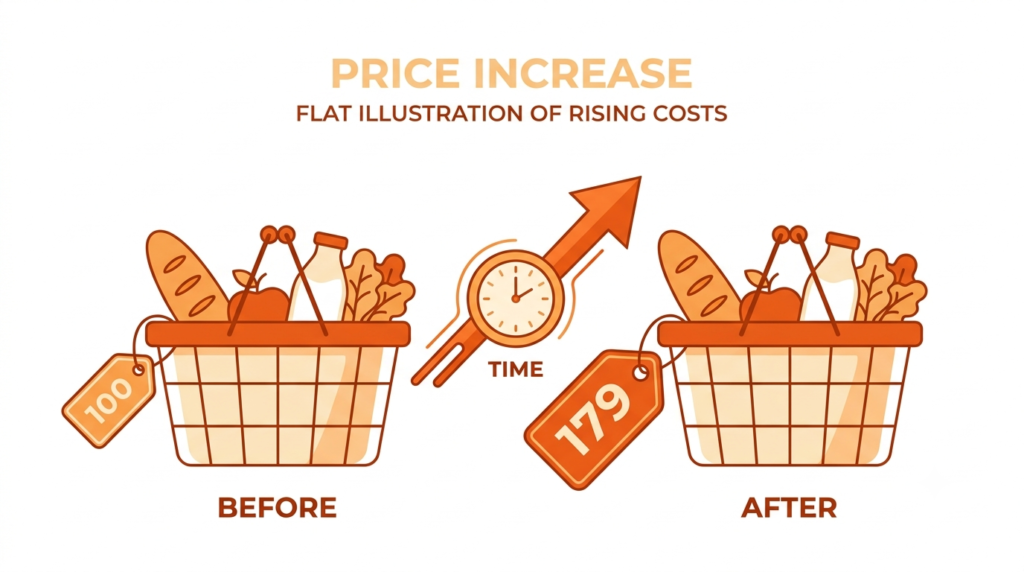
Example: at 6% inflation, an item costing 100 today costs about 179 in 10 years, and 1,00,000 today will buy only what about 55,840 buys now.
What Is Inflation?
Inflation is the general, sustained increase in the prices of goods and services in an economy over time. When inflation is positive, each unit of money buys fewer goods and services than before. In other words, it reduces the purchasing power of money.
Two points are worth noting. First, inflation is about the general price level. If only one item becomes more expensive, say tomatoes after a bad harvest, that is a relative price change, not inflation. Second, it is about sustained increases. A one-off jump does not count unless prices keep rising.
A small, steady amount of inflation is normal in healthy economies, and many central banks aim for a low, stable target rather than zero. Problems arise when inflation is high or unpredictable, because it erodes savings, makes planning harder and can hurt people on fixed incomes the most.
How Inflation Is Measured (CPI)
The most common measure is the Consumer Price Index (CPI). Statisticians define a “basket” of goods and services that typical households buy, such as food, housing, clothing, transport, health care, education and entertainment. They track the total cost of this basket over time and express it as an index number relative to a base period.
- Different items have different weights. Food usually has a large weight in the CPI of developing economies, since households spend a large share of income on it.
- The CPI is published regularly, typically monthly, by a national statistics office.
- Headline inflation includes all items, while core inflation strips out volatile items such as food and fuel to reveal the underlying trend.
- Another measure, the Wholesale Price Index (WPI), tracks prices at the wholesale level rather than what consumers pay.
Central banks such as India’s Reserve Bank of India operate within inflation-targeting frameworks. The target and tolerance band are set by policy and can be reviewed, so check the central bank’s website for the current framework. Your personal inflation rate may differ from the official figure, because your spending basket differs from the average. For example, a family spending a lot on school fees will feel education inflation more than the headline number suggests.
Calculating the Inflation Rate
To find the inflation rate between two dates, compare the price index at both dates. The formula is the standard percentage change formula, which you may know from our guide on percentage increase and decrease.
Inflation rate (%) = ((CPI now − CPI before) ÷ CPI before) × 100
Example 1: Using CPI
The CPI rises from 150 to 159 over a year. Inflation = ((159 − 150) ÷ 150) × 100 = (9 ÷ 150) × 100 = 6%.
Example 2: Using Your Own Prices
Your monthly grocery bill was 8,000 a year ago and is now 8,720. Your personal grocery inflation is ((8,720 − 8,000) ÷ 8,000) × 100 = 9%.
Example 3: Over Several Years
A cup of coffee cost 40 ten years ago and costs 72 today. Total price rise = (72 − 40) ÷ 40 = 80%. The average yearly rate is (1.80)^(1/10) − 1 ≈ 6.1% per year. This uses the annualizing method from our guide on how to calculate ROI.
Calculating Future Prices
To estimate what something will cost in the future, apply the inflation rate repeatedly. Because each year’s increase builds on the previous year’s price, the calculation uses a power, just like compound interest.
Future price = Price today × (1 + inflation rate)ⁿ
Example 1: A Basket Costing 100
At 6% inflation for 10 years: 100 × (1.06)¹⁰ = 100 × 1.7908 ≈ 179.08. Prices rise by about 79% in a decade.
Example 2: Monthly Household Expenses
Your family spends 50,000 a month today. At 6% inflation, in 20 years, you will need 50,000 × (1.06)²⁰ = 50,000 × 3.2071 ≈ 1,60,357 per month to live the same lifestyle. This is more than three times today’s amount.
Example 3: Education Cost
A course costs 10 lakh today. If education costs rise by 8% a year, then in 12 years it will cost 10 lakh × (1.08)¹² ≈ 10 lakh × 2.5182 ≈ 25.18 lakh.
Example 4: Short Period
A grocery bill of 5,000 at 5% inflation for 5 years becomes 5,000 × (1.05)⁵ = 5,000 × 1.27628 ≈ 6,381.
| Years | At 4% inflation | At 6% inflation | At 8% inflation |
|---|---|---|---|
| 5 | 121.67 | 133.82 | 146.93 |
| 10 | 148.02 | 179.08 | 215.89 |
| 20 | 219.11 | 320.71 | 466.10 |
| 30 | 324.34 | 574.35 | 1,006.27 |
The numbers grow dramatically over long periods. Even at 4%, prices more than triple in 30 years, and at 8% they increase tenfold. If the exponent calculations feel tricky, review our guide on square roots and exponents.
Purchasing Power of Money
Looking at inflation from the opposite side, ask: what will my money be worth in the future? Divide instead of multiply.
Purchasing power of an amount after n years = Amount ÷ (1 + inflation)ⁿ
Example 1: 1,00,000 After 10 Years at 6%
1,00,000 ÷ 1.7908 ≈ 55,840. In 10 years, 1,00,000 in cash will buy only what about 55,840 buys today. The money did not disappear; prices rose.
Example 2: 50,000 After 10 Years at 6%
50,000 ÷ 1.7908 ≈ 27,920. Roughly 44% of its buying power is lost.
Example 3: Savings Under the Mattress
If you keep 5 lakh in cash for 20 years at 6% inflation, its buying power becomes 5,00,000 ÷ 3.2071 ≈ 1.56 lakh in today’s terms. Keeping all savings in cash, earning nothing, is therefore a guaranteed loss of purchasing power over long periods.
The Rule of 72 for Inflation
For a quick mental estimate of how long it takes for prices to double, divide 72 by the inflation rate.
Years for prices to double ≈ 72 ÷ inflation rate (%)
- At 4% inflation: about 18 years.
- At 6% inflation: about 12 years.
- At 8% inflation: about 9 years.
- At 12% inflation: about 6 years.
The same rule tells you how fast your money’s purchasing power halves. At 6% inflation, in about 12 years your cash will buy half as much. The rule works best for rates between roughly 4% and 12%, and it is explained in more detail in our guide on compound interest.
Real vs Nominal Returns
The interest rate on a deposit or the return on an investment is usually quoted in nominal terms, before inflation. What really matters is how much your purchasing power grows, called the real return.
Real return = (1 + nominal return) ÷ (1 + inflation) − 1
A common approximation is real return ≈ nominal return − inflation, which works for small rates.
Examples
| Nominal return | Inflation | Real return (exact) | Meaning |
|---|---|---|---|
| 7% | 5% | 1.9% | Buying power grows slowly |
| 9% | 6% | 2.8% | Modest real growth |
| 12% | 6% | 5.7% | Healthy real growth |
| 4% | 6% | −1.9% | Buying power shrinks |
A deposit paying 4% while inflation runs at 6% looks like growth on your statement, but in real terms you are losing almost 2% a year. When comparing deposits, funds or other options, look at the real return. Our guides on SIP investing and simple interest help you work out nominal returns first. Also remember that taxes on interest or gains reduce your net return further.
Inflation and Long-Term Goals
Whenever you plan a future expense, adjust it for inflation first. Otherwise, you will save too little.
Step-by-Step Method
- Estimate today’s cost of the goal. For example, a 20 lakh course.
- Choose an inflation rate for that category, such as 8% for education.
- Calculate the future cost: 20 lakh × (1.08)¹⁰ ≈ 20 lakh × 2.1589 ≈ 43.18 lakh for a goal 10 years away.
- Work out the monthly investment needed. Our SIP calculator guide shows how to do this.
- Review every year and adjust.
Retirement
Retirement is where inflation bites hardest, because you may need your savings for 25 to 30 years or more. If you need 50,000 a month today and retire in 20 years at 6% inflation, you will need about 1.6 lakh a month in that year, and your needs will keep rising afterwards. Plan for a corpus that continues to grow after retirement, not a static pile of cash.
Loans and Inflation
Inflation can help borrowers with fixed-rate loans, because the fixed payment becomes smaller in real terms as prices and incomes rise. But lenders usually price this into the interest rate. See how repayments work in our guides on EMI and loan amortization.
Salary Hikes and Inflation
A raise is only a real raise if it beats inflation. Compare your percentage increase with the inflation rate.
- A 5% raise with 6% inflation gives a real change of (1.05 ÷ 1.06) − 1 ≈ −0.94%. You are slightly worse off in purchasing power.
- A 10% raise with 6% inflation gives (1.10 ÷ 1.06) − 1 ≈ +3.8% real growth.
When negotiating pay or comparing job offers, think in real terms. It is also useful to know your actual take-home pay, since taxes and deductions change how a hike feels. You can learn more in our guide on in-hand salary calculation.
Types and Causes of Inflation
Common Causes
- Demand-pull inflation: too much money chasing too few goods. When demand grows faster than supply, prices rise.
- Cost-push inflation: higher production costs, such as wages, raw materials or energy, are passed on as higher prices.
- Built-in inflation: people expect prices to rise, so workers ask for higher wages and firms raise prices, creating a cycle.
- Supply shocks: bad weather, supply chain disruptions or sudden fuel price changes can push prices up temporarily.
- Exchange rate effects: a weaker currency makes imports costlier.
- Money supply and policy: excessive money creation can contribute to long-lasting inflation.
Levels of Inflation
| Type | Description |
|---|---|
| Low or creeping inflation | Gradual price rises of a few percent a year, common in stable economies |
| Moderate inflation | Higher single-digit or low double-digit rises that start to erode savings noticeably |
| High inflation | Sustained double-digit rises that disrupt planning and contracts |
| Hyperinflation | Extremely rapid price rises, often defined as more than 50% a month, where money loses value almost daily |
Central banks fight inflation mainly by raising interest rates, which reduces borrowing and spending, and by managing liquidity. Governments can also use tax and supply-side measures.
Ways to Protect Your Money from Inflation
There is no single perfect shield. Different assets respond to inflation in different ways, and each carries its own risk. In general terms:
- Invest for growth over the long term. Assets such as equities and real assets have historically tended to grow faster than inflation over long periods, though with ups and downs and no guarantee.
- Look at inflation-linked products. Some governments issue bonds whose returns adjust with inflation.
- Do not keep large sums idle in cash. Keep an emergency fund, but invest the rest according to your goals.
- Increase your income. Build skills, negotiate raises and seek additional income streams.
- Raise your investments each year. A step-up SIP helps your savings keep pace with rising prices.
- Control lifestyle inflation. Spending more every time income rises can matter as much as price inflation.
- Review regularly. Reassess your plan once a year using updated inflation numbers.
This article is for general education and is not financial advice. Investment returns are not guaranteed. Please consider consulting a qualified adviser for decisions about your own money.
Deflation and Disinflation
Deflation is a fall in the general price level, meaning inflation is negative. It can sound pleasant, but sustained deflation can be harmful: consumers delay purchases expecting lower prices, businesses cut output and wages, and debts become heavier in real terms.
Disinflation is different. It means inflation is still positive but falling, for example from 7% to 5%. Prices are still rising, just more slowly. Mixing these two terms is common in news reports.
Common Mistakes
- Ignoring inflation in long-term plans. A target that sounds large today may be too small in the future.
- Treating nominal returns as real gains. Always subtract inflation to see true growth.
- Adding instead of compounding. 6% inflation for 10 years is a 79% price rise, not 60%.
- Using one average rate for everything. Education, healthcare and housing may rise faster than the headline rate.
- Confusing deflation with disinflation. Falling inflation does not mean falling prices.
- Believing a raise is automatically a gain. Compare it with inflation.
- Keeping too much in cash. Idle money loses purchasing power year after year.
- Over-relying on past inflation. Future rates can differ, so test your plan with several scenarios.
Practice Questions
- The CPI moves from 150 to 159. What is the inflation rate?
- A grocery bill is 5,000 today. What will it be after 5 years at 5% inflation?
- What will 50,000 be worth in today’s money after 10 years at 6% inflation?
- A deposit earns 9% a year while inflation is 6%. What is the real return?
- Use the Rule of 72 to estimate how long prices take to double at 8% inflation.
- You receive a 5% raise while inflation is 6%. What is the approximate real change?
Answers
- (9 ÷ 150) × 100 = 6%.
- 5,000 × 1.05⁵ ≈ 6,381.
- 50,000 ÷ 1.06¹⁰ ≈ 27,920.
- (1.09 ÷ 1.06) − 1 ≈ 2.8%.
- 72 ÷ 8 = 9 years.
- (1.05 ÷ 1.06) − 1 ≈ −0.94%.
Frequently Asked Questions
How is the inflation rate calculated?
Take the percentage change in a price index such as CPI: ((CPI now − CPI before) ÷ CPI before) × 100.
How do I calculate the future price with inflation?
Multiply today’s price by (1 + inflation)ⁿ. At 6% for 10 years, a price of 100 becomes about 179.
What is the purchasing power of money after inflation?
Divide the amount by (1 + inflation)ⁿ. At 6% over 10 years, 1,00,000 buys about what 55,840 buys today.
What is the difference between real and nominal return?
Nominal return is before inflation. Real return adjusts for inflation and shows the true growth in purchasing power.
How long does it take for prices to double?
Use the Rule of 72. At 6% inflation, prices double in roughly 12 years.
What is CPI?
The Consumer Price Index tracks the cost of a basket of goods and services bought by typical households, and is the main measure of consumer inflation.
Is some inflation good?
Low, stable inflation is generally seen as healthy because it encourages spending and investment and avoids the risks of deflation, but high or volatile inflation harms savers and planning.
Conclusion
Inflation is a slow, steady force that changes the value of every rupee you hold. Learn the three core formulas, for the inflation rate, the future price and the purchasing power, use the Rule of 72 for quick estimates, and always judge returns and raises in real terms. Build inflation into every long-term goal, from education to retirement, and make sure your savings grow faster than prices over time.
To test your own scenarios, use our free inflation calculator, and keep exploring with these related guides: